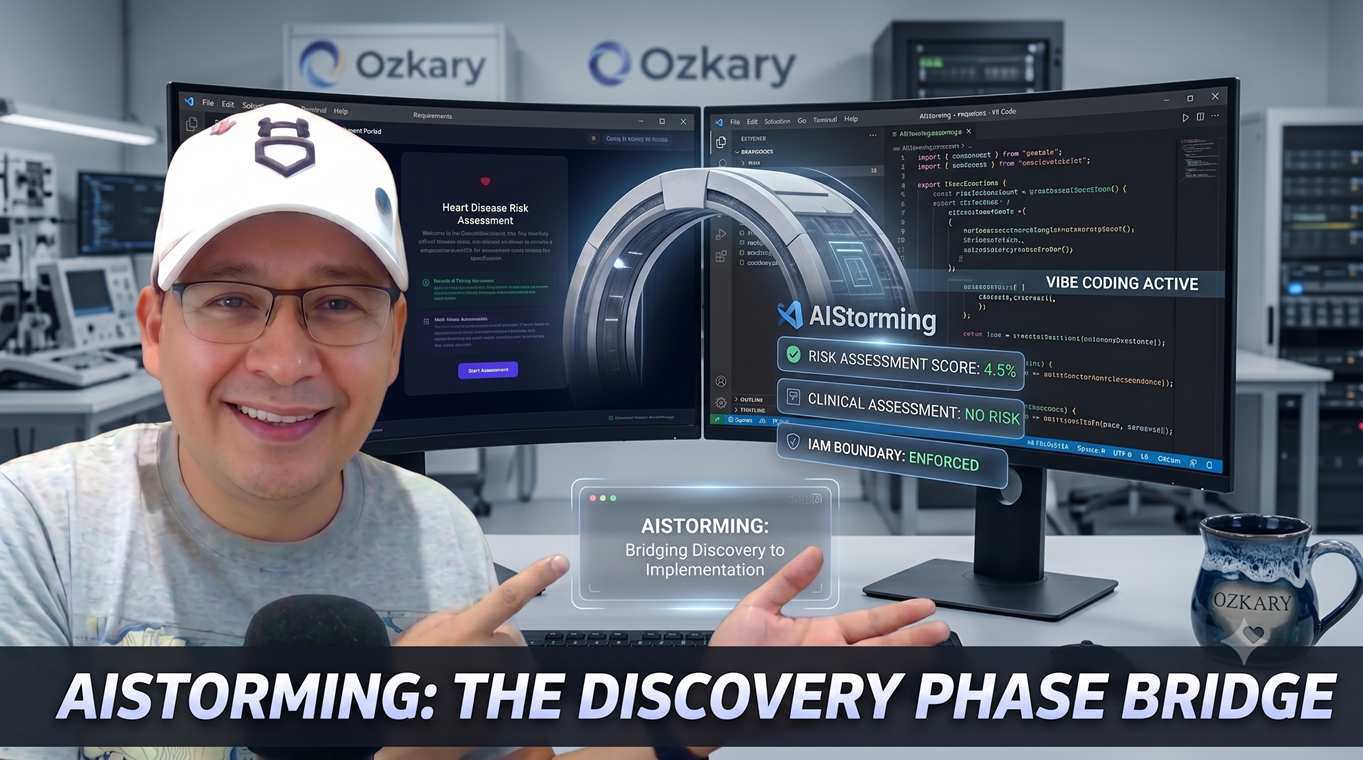
As the software development lifecycle shifts toward autonomous vibe coding, rapid AI prototyping, and Software Design Description (SDD) driven workflows, engineering teams face a critical structural bottleneck: the discovery and analysis gap. Generative AI tools excel at emitting syntactically valid code, yet they consistently fail when handed vague, ungrounded, or fragmented domain specifications.
To bridge the gap between initial domain exploration and deterministic engineering execution, I introduce AIStorming—a process-oriented framework born out of my engineering practice and foundational work in enterprise data pipelines and cloud-native application architectures.
Throughout my career designing high-scale cloud-native solutions, event-driven microservices, and modern data platforms, domain research, requirement validation, and exploratory design depended heavily on manual web searches, static documentation reviews, and disconnected whiteboarding sessions. Over years of hands-on practice, my workflow naturally evolved from manual research into AI-driven, interactive, and code-centric discovery. By leveraging AI coding assistants directly inside the development workspace to profile sample datasets, stress-test business rules, probe API interfaces, and validate system constraints in real time, I transformed traditional brainstorming into an active, deterministic engineering phase: AIStorming.
AIStorming formalizes the process of using AI coding tools (e.g., GitHub Copilot, Google Antigravity) to conduct real-time domain discovery, exploratory analysis, and system boundary mapping across both cloud-native software and data engineering domains. Rather than relying on abstract, non-executable IT discovery frameworks, AIStorming anchors domain analysis directly in executable code, version control, and data validation. This yields structured problem statements, refined use cases, quantifiable technical requirements, and machine-readable specifications optimized for vibe coding, cloud-native design, and automated SDD execution.
Explore these curated resources to level up your engineering skills. If you find them helpful, a ⭐️ is much appreciated!
Focus: Real-world ETL & MTA Turnstile Data

Focus: LLM Patterns and Agentic Workflows

Focus: Introduction to machine learning

💡 Contribute: Found a bug or have a suggestion? Open an issue! and be part of the open source project.
In traditional enterprise software engineering, product discovery is often disconnected from actual system implementation. Product managers, business analysts, and architects spend weeks producing static requirements documents, wireframes, or text-heavy stories. When these artifacts are passed down to software engineers—or fed as prompt context into AI coding tools—the implementation breaks down due to implicit assumptions, unverified data schemas, unexpected edge cases, and missing operational constraints.
In an era dominated by AI-assisted synthesis, garbage context in results in garbage execution out.
+-----------------------------------------------------------------------------------+
|                            TRADITIONAL DISCOVERY GAP                              |
|                                                                                   |
|  [ Domain & Business ] ---> ( Static Docs / Whiteboards ) ---> [ AI Assistant ]   |
|  Ideation & Concepts          Unverified Context                 Hallucinated     |
|                                                                  Implementation   |
+-----------------------------------------------------------------------------------+
                                        VS.
+-----------------------------------------------------------------------------------+
|                             AISTORMING FRAMEWORK                                  |
|                                                                                   |
|  [ Domain Input ]  ---> { AIStorming: Code-Centric Analysis } ---> [ SDD & Vibe ] |
|  Raw Data / Rules /     Exploratory Scripts, Profiling,         Deterministic     |
|  API Contracts          & Requirement Synthesis in IDE             Builds         |
+-----------------------------------------------------------------------------------+
To leverage AI coding assistants safely and at enterprise quality, the Discovery Phase must be reinvented. It can no longer be a passive ideation exercise; it must become an active, code-centric discovery engine that validates domain facts, data structures, and service behaviors before full-scale software architecture and implementation begin.
AIStorming is the process-oriented methodology of conducting domain discovery, exploratory data/logic analysis, and system boundary definition by pairing human engineering expertise with AI coding tools inside an Integrated Development Environment (IDE).
The objective of AIStorming is not to generate production application code or deploy live systems immediately. Instead, its primary output is a structured set of verified, code-grounded engineering artifacts:
Derived from the universal tenets of my Data Engineering Process Fundamentals (DEP) and expanded across cloud-native software architecture, AIStorming adapts proven discovery mechanics to AI-driven developer tooling.
Traditional discovery relies on prose descriptions that fail upon first contact with compiler logic, schema validation, or streaming engines. AIStorming dictates that discovery must be code-centric from day one.
AI models hallucinate when operating in an isolated context vacuum. AIStorming requires immediate grounding against real-world sample datasets, schema definitions, domain models, and API interfaces.
Prompt histories floating in web interfaces are disposable, non-reproducible, and unmaintainable. AIStorming enforces that every discovery artifact—exploratory notebooks, schema models, interface definitions, and context files—is checked directly into a Git repository (e.g., GitHub).
AIStorming serves as the explicit precursor to Vibe Coding (rapid, intent-driven application development using AI models) and Software Design Description (SDD) generation. By translating loose ideas into code-verified constraints during AIStorming, downstream AI models receive high-fidelity, hallucination-free prompts during full-scale development.
Whether applied to cloud-native microservices, event-driven streaming applications, serverless architectures, or modern enterprise data platforms, the AIStorming framework executes across four process-oriented phases.
+-------------------+      +-------------------+      +-------------------+      +-------------------+
|  STEP 1:          | ---> |  STEP 2:          | ---> |  STEP 3:          | ---> |  STEP 4:          |
|  Problem          |      |  Exploratory      |      |  Use Case &       |      |  SDD & Vibe       |
|  Framing &        |      |  Data & Domain    |      |  Requirement      |      |  Specification    |
|  Context Prime    |      |  Analysis         |      |  Synthesis        |      |  Output           |
+-------------------+ +-------------------+ +-------------------+ +-------------------+CONTEXT.md or system prompt boundaries) containing raw business objectives, domain rules, SLA requirements, and target application guidelines.SPEC.md / ARCHITECTURE.md).To maintain enterprise quality, an AIStorming session must terminate in a concrete set of repository artifacts:
| Deliverable Phase | File Artifact | Content & Purpose | Target Consumer |
|---|---|---|---|
| Problem Definition | PROBLEM.md |
Domain boundaries, business goals, explicit out-of-scope declarations | Lead Engineers & Architects |
| Exploratory Analysis | analysis/*.ipynb, scripts/* |
Executable data profiling, edge-case tests, API contract probes | Engineering Team & AI Agents |
| Use Cases | USE_CASES.md |
System interactions, domain event triggers, failure modes, retry logic | Product Owners & Testing Engines |
| Technical Specs | REQUIREMENTS.md, SPEC.md |
Data models, storage schemas, security boundaries, SLA performance targets | Vibe Coding AI Tools (Cursor, Copilot, Claude) |
| Architecture Contract | ARCHITECTURE.md, schemas/* |
System topology, ERD models, OpenAPI/AsyncAPI specs, CI/CD pipeline rules | SDD Generators & Developers |
To demonstrate the versatility of AIStorming across cloud-native microservices and high-scale data platforms, consider the execution path of a modern enterprise solution:
REQUIREMENTS.md via AIStorming to explicitly mandate upstream payload sanitization, dead-letter routing (DLQ), and a strict contract enforcement layer.SPEC.md, Pydantic models, and OpenAPI/AsyncAPI specs are fed into coding agents. The agents write production-grade microservices and pipeline code on the first pass because the domain edge cases were caught during AIStorming.As artificial intelligence shifts software and data engineering from manual syntax writing to high-level system orchestration, the role of the engineer evolves from code writer to system architect and discovery strategist.
AIStorming bridges the foundational gap between raw domain ideas and deterministic execution. By marrying the process-oriented discipline of Data Engineering Process Fundamentals with cloud-native software architecture patterns and modern AI coding tools, AIStorming transforms discovery from a passive, unverified discussion into a repeatable, code-centric, and auditable engineering standard.
By adopting AIStorming as a formal phase prior to vibe coding and SDD execution, engineering organizations can eliminate AI hallucination risks, enforce enterprise domain integrity, and accelerate software delivery with complete architectural control.
Thanks for reading! 😊 If you enjoyed these resources, let's stay in touch! I share deep-dives into AI/ML patterns and host community events here:
👉 *Originally published at ozkary.com*


