
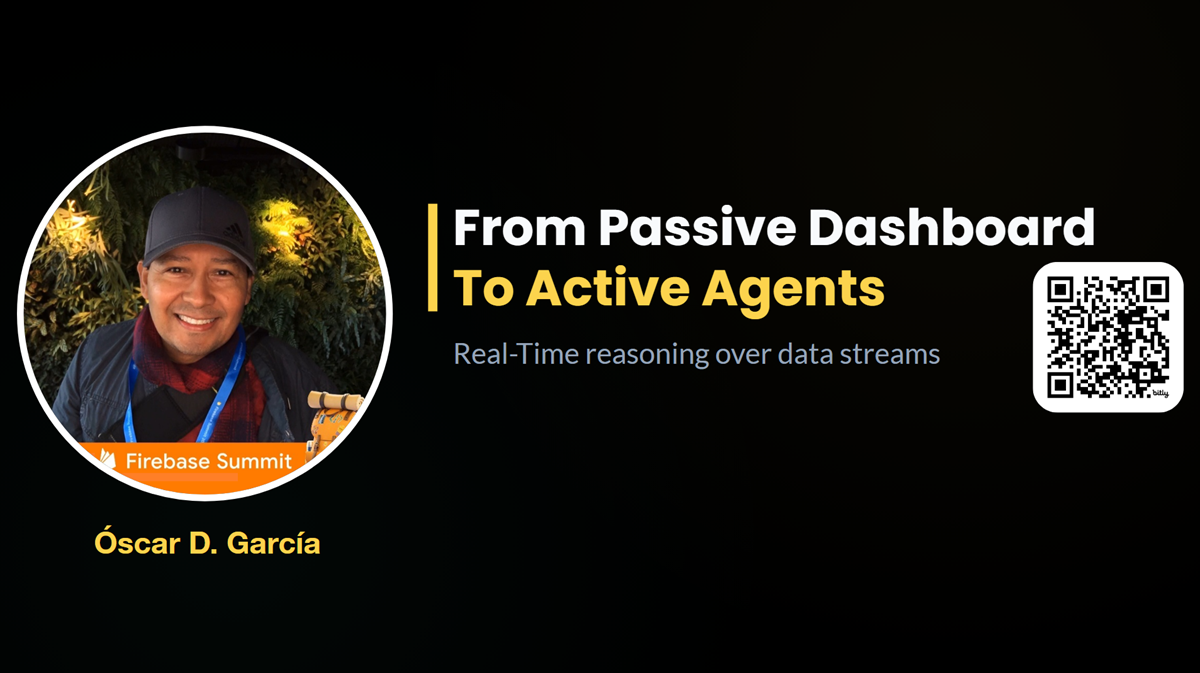
From Passive Dashboards to Active Agents: Real-Time Reasoning over Data Streams
Overview
Dashboards are effective at showing us that something is breaking, but they usually rely on a human to watch the screen and decide what to do next. In this session, we will look at how to take a standard real-time telemetry dashboard and make it autonomous.
We will walk through a practical implementation using an Angular frontend and a Node.js server. We’ll look at how the system leverages a relational database for persistence and a Redis in-memory cache to handle high-frequency and short volume data feeds. From there, we incorporate an AI Agent that follows three core principles: perceiving the data stream through a sliding window, reasoning against statistical control limits, and acting by sending real-time analysis back to the user. This session is focused on bridging the gap between raw data streams and automated decision-making.
🚀 Featured Open Source Projects
Explore these curated resources to level up your engineering skills. If you find them helpful, a ⭐️ is much appreciated!
🏗️ Data Engineering
Focus: Real-world ETL & MTA Turnstile Data


🤖 Artificial Intelligence
Focus: LLM Patterns and Agentic Workflows


📉 Machine Learning
Focus: MLOps and Productionizing Models


💡 Contribute: Found a bug or have a suggestion? Open an issue! and be part of the open source project.
🔗 Review the repo used for this presentation:

Tech Stack







YouTube Video
👍 Subscribe to the channel to get notify on new events!
📅 Agenda
- The Real-Time Feed: Monitoring Device Telemetry
An introduction to the live system where devices emit high-frequency data for quality monitoring and $3\sigma$ control limit oversight.
- System Architecture: From Ingestion to Persistence
A deep dive into the technical stack, mapping out the data journey through Node.js, Redis in-memory caching, and relational database storage.
- The Human in the Loop: Cognitive Limitations
Exploring the “Passive Monitoring” challenge—why relying on human interpretation of real-time alerts creates a bottleneck in process control.
- The AI Agent: Applying the 3 Principles
Implementing the “Active Observer” using the three core pillars of AI Agents: Perception (the window), Reasoning (the limits), and Action (the analysis).
- The Intelligent Journey: Summary & Advantages
Recapping our transition from a passive monitor to a smart system and discussing the advantages of automated, agentic data interpretation.
⭐ Why Attend?
The industry is moving beyond simple “Chat” interfaces and into the realm of Agentic Observability. By attending this session, you will see a practical blueprint for integrating intelligence directly into a high-velocity data stack.
👥 Who Is This For?
- Junior Developers: Learn the fundamentals of real-time streaming, how to manage state in Node.js, and how to interact with AI APIs in a professional environment.
- Senior Engineers & Architects: See a robust architectural pattern for integrating Redis, relational databases, and AI Agents while maintaining system stability and security.
- Decision Makers (VPs/Directors): Understand the ROI of “Active Monitoring”—how AI Agents can act as a force multiplier for your engineering teams by automating the first layer of data interpretation.
- Quality & Reliability Engineers: Explore how to digitize the control limit logic you already use into an autonomous 24/7 “Digital Twin.”
Presentation
The Real-Time Feed Challenge
High-velocity telemetry defines the “digital pulse” of modern industrial systems.
- Telemetry Streams: Industrial devices emit continuous telemetry (Temperature, Sound, Humidity). These data points require sub-second processing to maintain operational stability.
- Control Limits: Quality engineers rely on statistical boundaries to define “normal” operation. Detecting drift is the critical first step in identifying risks before failure occurs.
Scalable System Architecture
A multi-layered stack designed to bridge the gap between ingestion and intelligence.
- Redis Cache: Manages the “Live State” or Digital Twin. Provides sub-millisecond access for immediate AI perception.
- Relational Data Warehouse: Powers the historical persistence layer for long-term trend analysis and compliance auditing.
- Node Controller: The orchestration hub. Manages telemetry ingestion, state updates, and the execution of the agentic reasoning loop.
The “Human in the Loop” Trap
Passive observability relies on human interpretation, creating a critical bottleneck.
- Cognitive Overload: Humans struggle to interpret hundreds of concurrent streams, missing subtle patterns.
- Alert Fatigue: Constant threshold violations desensitize responders, causing critical $3\sigma$ violations to be ignored.
- Response Latency: The time required for a human to interpret a dashboard often exceeds the window for effective corrective action.
The 3 Principles of AI Agents
Automating observability requires a system that can perceive, reason, and act independently.
- Perception: Maintaining a stateful sliding window of the Digital Twin to understand temporal context.
- Reasoning: Evaluating the stream against statistical $3\sigma$ limits and physical engineering constraints.
- Action: Closing the loop by emitting real-time narratives or triggering autonomous safety protocols.
The Intelligent Journey: Comparison
| Feature | Passive Monitor | Smart Monitor |
|---|---|---|
| Interpretation | Requires human “eyes-on-glass” | Autonomous, semantic interpretation |
| Response | Reactive to simple thresholds | Proactive identification of drift |
| Reliability | High risk of missed signals | Intelligent filtering of noise |
| Data Context | Disconnected historical vs. live | Stateful perception of “Live Device” |
| Intervention | Significant human latency | Automated safety & audit narratives |
🌟 Let’s Connect & Build Together
Thanks for reading! 😊 If you enjoyed these resources, let’s stay in touch! I share deep-dives into AI/ML patterns and host community events here:
- GDG Broward: Join our local dev community for meetups and workshops.
- Global AI Events: Join Global AI Events.
- LinkedIn: Let’s connect professionally! I share insights on engineering.
- GitHub: Follow my open-source journey and star the repos you find useful.
- YouTube: Watch step-by-step tutorials on the projects listed above.
- BlueSky / X / Twitter: Daily tech updates and quick engineering tips.
👉 Originally published at ozkary.com
Leave a comment